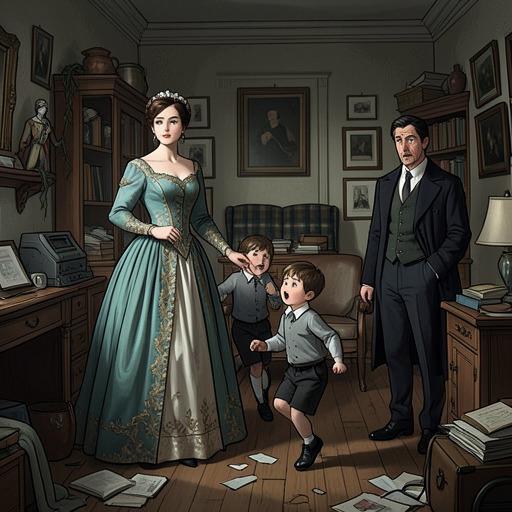
Miss Havisham's repentance
Great ExpectationsMiss Havisham’s repentance is a late recognition of the damage caused by her attempt to shape Estella in the image of her own heartbreak. Before Pip, she confesses that she stole Estella’s heart and put ice in its place; she asks him to write “I forgive her” beneath her name, and Pip grants forgiveness while insisting that remorse must give way to an effort to repair what can still be repaired. The encounter turns a history of manipulation into a scene of accountability, compassion, and belated moral understanding.
The damage behind the confession
Pip’s understanding of his own history has already been overturned. He once imagined that Miss Havisham meant to bring him and Estella together, and that he was destined to restore the decaying house and marry its young mistress. He later recognizes that Estella was never designed for him: he had been used at Satis House as a means of hurting Miss Havisham’s greedy relations and as a model on which she could practise her emotional designs. His love for Estella, though profound, had never been evidence that she was promised to him.
That reversal makes his response to Miss Havisham more complicated than a simple settling of scores. He remembers his own ingratitude and the shame he felt toward Joe and home, but later admits that the precise share of blame belonging to himself, Miss Havisham, or his sister no longer matters: the change in him had been made. The chain formed on one memorable day, he reflects, could bind a life with links of iron or gold, thorns or flowers. In this retrospective account, Miss Havisham’s influence is real, but it does not cancel Pip’s own responsibility for the choices that followed.
The revelation that Pip’s expectations were not Miss Havisham’s plan leaves him facing a second injury: his treatment of Joe. Once the truth about his benefactor and his imagined future has collapsed, Pip’s sharpest pain is that he deserted Joe for the sake of a convict whose crimes he does not even know. He cannot bring himself to return to Joe or Biddy, because he believes his own conduct has made him unworthy of their constancy. His remorse thus precedes Miss Havisham’s confession and helps establish why he can meet her without answering injury with bitterness.
A plea and a physical surrender
Miss Havisham asks Pip to take a written statement intended to clear him of any suspicion that he has profited from money she gives him. As she hands him her tablets, her hand trembles; she then removes the pencil from its chain and places it in his hand. Her request turns the writing into a possible record of forgiveness: she asks that, even after her broken heart has become dust, he write “I forgive her” beneath her name.
Pip answers that he can forgive her already. He admits that his life has been blind and thankless and says he needs forgiveness and direction too much to remain bitter. His reply does not deny the wrong or claim that its consequences can simply be undone. Instead, the exchange places the two of them within a shared need for moral correction: the person who once wielded power over his hopes now kneels before him, asking for mercy.
Miss Havisham drops to her knees with her folded hands raised. Her white hair and worn face make the gesture a stark reversal of the authority she exercised over the boy she summoned to Satis House. Pip is shocked, tries to raise her, and holds her as she clings to his hand and weeps. He has never seen her cry before. Her repeated cry, “What have I done!”, gives her recognition a bodily force, but repetition also shows that recognition alone cannot restore what has been lost.
Recognition without repair
Pip understands that Miss Havisham did a grievous thing when she took an impressionable child and moulded her into an instrument of wounded pride and resentment. He also sees that the harm was not limited to Estella. By shutting out daylight and withdrawing from ordinary life, Miss Havisham shut herself away from the natural influences that might have healed her; solitary brooding, in Pip’s judgment, had made her mind diseased. Her suffering is both a consequence of the original heartbreak and a punishment sustained by the life she built around it.
Miss Havisham explains that she first meant to save Estella from a misery like her own. As Estella grew beautiful, however, Miss Havisham did worse: through praise, jewels, lessons, and the example of her own ruined life, she took Estella’s heart away and put ice in its place. The confession clarifies how an intention she once understood as protection became emotional manipulation. Estella’s coldness was not simply an innate quality; Miss Havisham acknowledges that she helped produce it.
Pip does not let the confession substitute for concern about Estella. He tells Miss Havisham that he can be dismissed from her conscience, but Estella is a different case. If Miss Havisham can undo even a scrap of the harm done by keeping part of Estella’s nature from her, that effort would matter more than lamenting the past for a hundred years. His distinction gives repentance a practical test: sorrow is not enough unless it turns toward the person who was shaped by it.
Significance in Pip’s moral history
The scene brings together two admissions of damage. Miss Havisham recognizes what she did to Estella; Pip, in recalling the collapse of his expectations, recognizes that his own shame and ambition led him to abandon Joe. When Joe later tends Pip during his illness, his tact and kindness make a deep impression. Joe does not force Pip to dwell on childhood secrets or humiliate him over his lost fortune. Pip also understands, as he grows stronger, why Joe grows less at ease: his earlier coldness gave Joe reason to fear that prosperity would make him cast off their bond again. Forgiveness in the novel is therefore not an excuse to forget conduct, but an opening through which conduct can be changed.
Miss Havisham’s repentance cannot reverse Estella’s upbringing or recover the natural affection that was suppressed. Its significance lies instead in the moment when Miss Havisham names her own part in the harm and Pip refuses to make his injury the last word. His forgiveness answers her plea; his insistence on Estella’s welfare prevents that answer from becoming mere absolution. The scene allows compassion and judgment to stand together: Miss Havisham is capable of remorse, yet she must face what her choices made of another person.